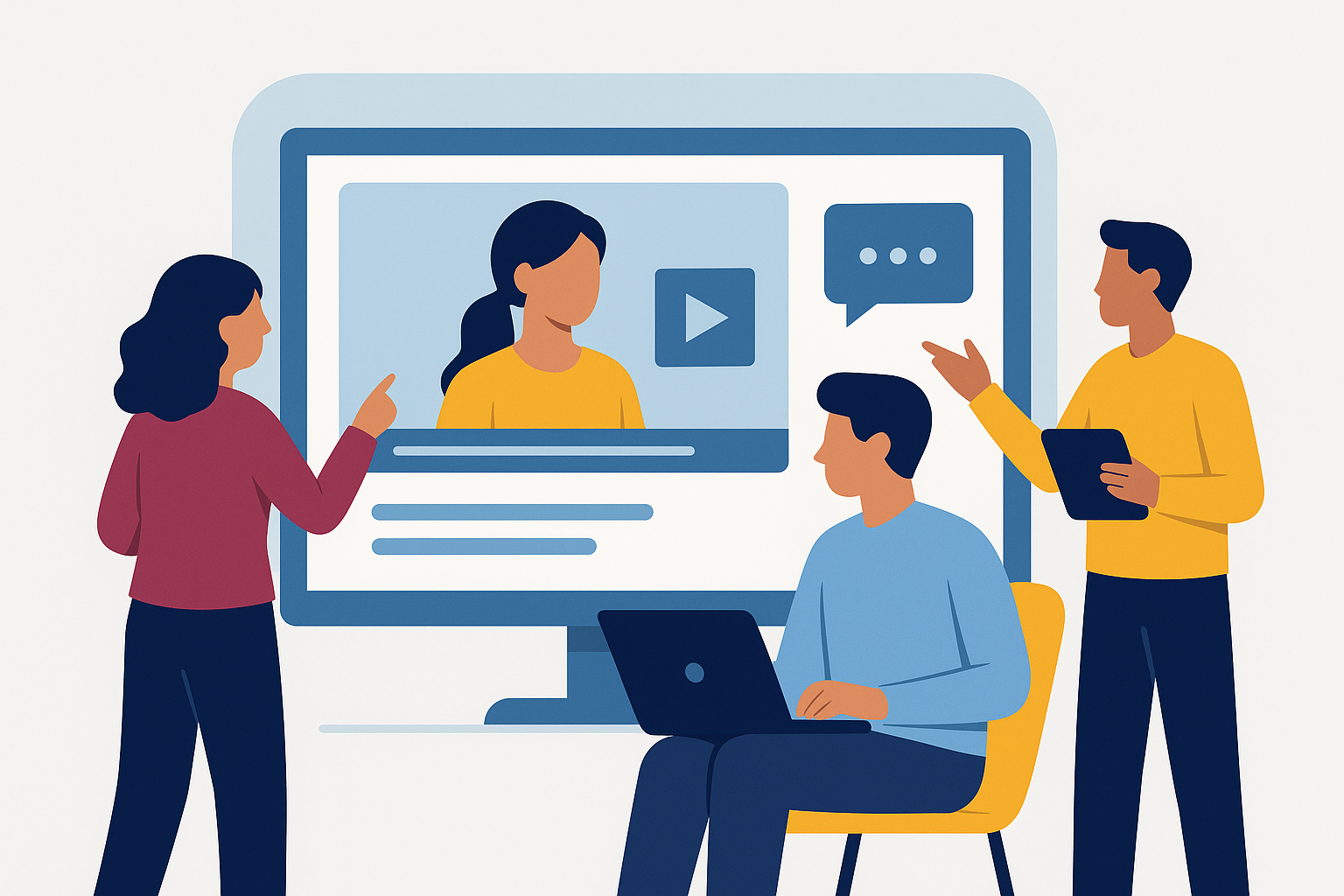
Think back to your college days…what classes do you remember most? Chances are, regardless of major or credits earned, they’re probably the ones that unexpectedly changed your perspective, where an instructor seemed to go the extra mile to help you, or in which you felt a true sense of belonging. What your most memorable classes all have in common is that they engaged you.
Student engagement is the degree of attention, curiosity, interest, optimism, passion, and motivation students show to learn or when being taught. It takes into account the cognitive and social-emotional relationship between the student and the class community, the student’s peers, the instructor, and the curriculum — and significantly impacts performance, achievement of learning outcomes, and a student’s overall learning experience.
If you’re new to or have just a couple years of experience teaching online, this article is for you. In addition to understanding the different learning approaches you can take to engage students, you’ll gain valuable insight into how to create a sense of classroom community that deepens students’ belonging and leads to a more enriching online learning experience.
If you’re a seasoned online instructor, this guide will give you a fresh take on how to approach your courses for maximum engagement. You’ll pick up tips that will help you engage students in new ways and discover ideas that can help you build online learning experiences that are just as rigorous as in-person experiences.
Why Increasing Online Student Engagement Matters
Engaging students in general is challenging and requires effort. Engaging students who are learning online presents a unique set of challenges. Because they’re not physically present in a classroom, online students lose more of the opportunities to interact, collaborate, and receive real-time feedback from instructors — all of which can create a sense of isolation and impact a students’ confidence and morale. Add to these challenges the fact that most of your students are juggling multiple responsibilities while taking your course, it’s no surprise online learners tend to struggle more than those in face-to-face courses, which has typically led to a 10-20 percent lower retention rate than traditional courses.
Student engagement, however, will be your key to driving success in an online learning environment. When a student feels motivated to participate in class, you’ll see signs they want to engage; and an engaged student is more likely to persist through challenges in learning, desire a deeper understanding of the material, and achieve learning goals. In this guide, we focus on strategies proven to help students more deeply engage while learning online. We’ll explore both instructor-driven and student-driven engagement tactics that are intended to counter many of the unique challenges online students face.
3 Keys to Increasing Engagement Online
- Excellent guidance & expectations, which include a range of instructional materials, expectations for participation, and feedback for improvement.
- Using a variety of mediums like video, the learning medium of choice for college-age students, and other multimedia that includes orientation to the course and time management.
- Create opportunities for connection, communication, and collaboration with you and among students to enable social learning.
|
Set Expectations & Provide Ongoing Guidance
Many students struggle with self-regulated learning, and help-seeking can be a problem. This issue manifests in two ways in online courses: students don’t recognize when they need help so poor performance leads to demoralization and disengagement OR they just don’t know where to get support or feel uncomfortable about accessing virtual help.
That’s where expectations, guidance, and support come in. How you choose to kick off your online course can set the tone for a student’s level of engagement. Err on the safe side and assume most students don’t plan well and have never taken an online course before.
Providing clear expectations, resources, and guidance for how, where, and when to complete your assignments is important. And just when you think you might be providing too many resources, remember that each student coming into your course has a different level of requisite knowledge.
How To Set the Stage
At the start of the course and at the top of every lesson:
✔ Remind students how and where to find course material, and explain how that material aligns with the objectives of the course.
✔ Clearly explain how students will be evaluated and how participation will be assessed.
✔ Keep due dates for important assignments top of students’ minds and make sure a syllabus and online rubric tied to the course’s learning outcomes are highly visible.
✔ Anticipate potential questions from students and consider preparing a quick FAQ resource.
✔ Share ongoing feedback, which is proven to motivate students to continue engaging, so each student feels more connected to you and has an opportunity to improve for the next lesson.
✔ Use video and image annotation tools to create orientation materials or provide more engaging feedback.
✔ Use milestones for certain course activities. Milestones intentionally guide students through a series of interactions designed to practice one-on-one and small-group collaboration — and are especially important for reinforcing significant or relevant concepts. The more often students interact within the course, with the material and each other, the more likely they are to engage. Milestones keep students on track and ensure that the participation is both regular throughout the course and more substantial.
Because you’re not in the physical classroom with your students, you’ll have to go the extra mile to keep students on track and aware of what you expect throughout the course, if you want to keep them engaged.
Milestones or multiple due dates in Harmonize set expectations and guide students through a series of interactions.
Leverage a Variety of Multimedia for Content Delivery
Video has revolutionized the delivery of information. In fact, new research digs deeper into why students prefer YouTube to study and learn, while additional studies find that 83% of people prefer watching videos to access information or instructional content.
Video, images, and other digital media are important tools that can help bolster the educational experience, working to illustrate complex ideas with the help of visual and audio learning elements. In addition to keeping students more engaged with your content, multimedia promotes:
- A deeper understanding: According to research, a benefit of multimedia learning is that it takes advantage of the brain’s ability to make connections between verbal and visual representations of content, leading to a deeper understanding, which in turn supports the transfer of learning to other situations.
- Improved problem solving: Using images, video and animations alongside a text stimulates the brain. Student attention increases, allowing students to identify and solve problems more easily compared to a scenario where text is the only medium for consumption.
- Increased positive emotions: Using multimedia during instruction can impact a student’s mood and induce positive emotions during the learning process that in turn facilitate better comprehension.
How To Optimize Your Use of Multimedia
Consider employing a variety of multimedia, including video, to deliver your course materials.
✔ Use open educational resources and other forms of readily available media, like podcasts, simulations, case studies, images, video, multimedia, and interactive learning objects to deliver concepts to students.
✔Share perspective through recorded video microlectures to synthesize key concepts in the course material.
✔ Post friendly video reminders of due dates. When you offer instructional content and resources in a variety of ways, you’re going to be able to reach a broader set of students.
✔ Encourage students to submit assignments using a variety of multimedia, from pictures and video to written text and audio snippets.
Consider the impact of short weekly video introductions on upcoming content and course activities. Your instructors will draw attention to important concepts and provide the continued guidance and clarity that keeps students on track. When there isn’t an opportunity for in-person interaction, being deliberate about creating those opportunities in an online environment will create a stronger sense of connection.
Plus, offering students a choice in how they submit their work but still fits within your parameters will give students a broader range of expression and support a more inclusive approach to learning. All together, a multimedia-rich learning environment will have a direct and positive effect on your students’ learning.
Build Community through Connection, Communication & Collaboration
Whether it be the lack of face-time with instructors or other students or the sense of isolation online learners may experience, online learners struggle more than those in face-to-face courses — and part of the reason is attributed to the loss of natural interaction and community they would experience in a physical classroom.
Don’t underestimate the power of building community. When a class becomes a community, students change from being passive learners to active learners. Building community also changes the class experience from impersonal to personal. A hefty amount of educational research highlights the benefits of collaborative learning. For example, a national study of more than 80,000 first-year and senior college students found that participating in a learning community, where a group of students takes multiple classes together, was associated with higher levels of engagement, satisfaction and learning outcomes.
When students feel they belong to a class community, they are more likely to be motivated to complete class work, feel safe enough to ask questions or for more help, and be open to feedback that can help them improve.
How To Promote Community
Beyond being the content expert, you now must step into the often-unspoken role as an online community builder in order to create meaningful moments for interaction and collaboration online. Here are some ways to do it.
Instructor Driven
✔ Create online partner pairs. Pair up students at the beginning of the course, so each student has built-in peer support and someone they can go to — besides you — to ask questions and share experiences. Encourage them to communicate via course chat, text, and video.
✔ Engage your students in a course discussion about a particular topic as part of the class curriculum to help them not only improve their critical thinking skills but also encourages them to engage with others in the class in a meaningful way. Establish this conversation as a forum to connect with each without the pressure of a graded assignment. Here are some best practices for online course discussions.
✔ Create a Q&A board for the class so they can post questions and crowdsource responses.
✔ Host virtual office hours to make yourself available to students, especially important when you don’t see them face-to-face throughout the week. Virtual office hours can be as simple as web conferencing with an individual or small group of students. Or it could involve adding a chat for those students who just want to have a brief connection.
Student Driven
✔ Incorporate students’ experiences and expertise. Students come to your course with a wide range of knowledge and experiences, and have insights to share. For example, invite students, independently or in small groups, to solve math problems in front of their peers (virtually) and explain their solutions. Involving students as teachers heightens interdependence, mutual respect and engagement—all of which are valuable in community building.
✔ Give them space to connect virtually via group projects and synchronous meetings to keep them engaged.
✔ Have students share videos and photos on what they hope to get out of your course.
Many of these tactics require a set of online collaboration tools, but with the right tools and flexibility to try new community-building activities throughout your course, you can help students learn together.
Vibrant, multimedia grid-like discussion boards in Harmonize.
Your Checklist for Teaching Engaging Courses Online
Teaching and learning online is hard enough. When you focus on creating an online environment that values social connection, consistency, community, and experiential learning, students are more likely to engage and come away with a more meaningful experience.
Because your students are learning online, the technology you choose to facilitate the strategies covered in this guide is critical. When implementing these strategies, the last thing you want to do is create additional obstacles for students that lead to less participation. A few reminders:
✔ Don’t Create Additional Barriers: Don’t make things hard to access or find, hard to follow, or hard to use. You’ll be inundated with emails from students and spend more of your time there than on actual teaching. Rather, find technology and tools that are intuitive to students. This is important because most online learners are looking for the quickest way to achieve their goals and expect speed at all points in their online learning experience.
✔ Don’t Shy Away from Collaboration: As humans, we are social creatures. We need human interaction. And when students are not collaborating with classmates, they miss out on that social element, new perspectives, alternative ways to solve problems, and opportunities to practice providing and receiving feedback. Consider implementing instructional strategies and tools that provide those same kinds of in-person opportunities online. Consider peer reviews and guided collaborative activities to help you increase student engagement.
✔ Don’t Spend Time Doing Manual Work: Online learning, like its name implies, should be a technology-enabled process that removes administrative burden. When you implement an online discussion & collaboration tool that integrates with your LMS to facilitate online courses, you’re going to eliminate many of the manual, often time-consuming tasks many instructors spend hours on. Make sure it has streamlined grading capabilities, plagiarism and AI-writing detection, and assessment analytics — all integrated with your LMS so you never have to leave the system.
✔ Don’t be Leary of Analytics: Data is our friend — you know that best. So what if you knew which students in your online courses were struggling or needed more attention. With Engagement Insights baked into your tools, you now have data behind your hunches on who may need additional support, so you can provide that extra layer of guidance that gets them back on track.
With these reminders top of mind and these engagement strategies a part of your online course toolkit, you’ll be able to kick student engagement into high gear. Remember, just like the classes you remember most, the most engaging courses will adapt to the way students learn, introduce a variety of approaches throughout the course, and as a result, deliver an effective and meaningful experience from wherever students choose to learn.
See Harmonize in action
Learn how you can improve online student engagement